Barbra Streisand Free Again Vynl Album
| Lazy Afternoon | ||||
|---|---|---|---|---|
 | ||||
| Studio anthology past Barbra Streisand | ||||
| Released | Oct 14, 1975 (1975-10-14) | |||
| Recorded | April 1975 (1975-04) | |||
| Studio |
| |||
| Genre | Pop standards | |||
| Length | 36:03 | |||
| Label | Columbia | |||
| Producer |
| |||
| Barbra Streisand chronology | ||||
| ||||
| Singles from Lazy Afternoon | ||||
| ||||
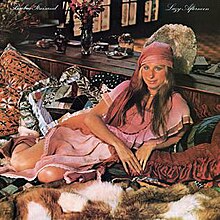
Lazy Afternoon is the seventeenth studio album recorded by American singer Barbra Streisand. It was released on Oct 14, 1975 by Columbia Records. Post-obit a mixed disquisitional response to her previous studio album, ButterFly (1974), the singer began working with new musicians for the projection. Recorded in April 1975 in Los Angeles, Lazy Afternoon contains pop standards. Producer Rupert Holmes wrote 3 songs on the anthology, and co-wrote a quaternary, "By the Mode", with Streisand. She also included a few comprehend songs, such every bit Four Tops' "Shake Me, Wake Me (When It's Over)", Stevie Wonder's "You and I", and Libby Holman'south "Moanin' Depression".
The album received generally favorable reviews from music critics who agreed that it was more exciting than ButterFly. Commercially, the album peaked at number 12 on the U.s.a., number 42 in Canada, and number 84 in Australia. It was afterward certified gold by the Recording Industry Association of America for shipments of 500,000 copies. "My Father's Song" and "Milk shake Me, Wake Me (When It's Over)" were released equally singles in August and Nov 1975, respectively. The onetime entered the Adult Contemporary charts in the United States and Canada while the latter was a success on two of Billboard 'southward dance charts in late 1975.
Development [edit]
Following the release of the Funny Lady soundtrack before in 1975, Streisand began work on Lazy Afternoon with producers Jeffrey Lesser and Rupert Holmes, with whom she had not previously worked.[ane] [2] Because of the lackluster critical response to her previous anthology, ButterFly (1974), and her personal dislike for the record, she chose to collaborate with new musicians for the then-upcoming album.[3] [4] [5] Holmes, in particular, was nervous while working with the singer. Following the completion of the anthology, Streisand manus-wrote a notation to Holmes that read, "Dear Rupert, don't exist frightened, you're the best, love Barbra".[half-dozen] Specifically, she was touched by "My Father's Song", writing in the liner notes that she considered the song to be "a very personal gift [that] means a bang-up to bargain to me".[7]
Recording sessions for the album took place at Record Found, RCA Studios, and Capitol Recording Studios in Los Angeles in April 1975.[7] Columbia Records released Lazy Afternoon on October xiv, 1975.[8] Information technology features handwritten liner notes developed by Streisand herself; she opened the booklet past writing, "While I commonly let the vinyl speak for itself, I really had fun making this tape, and I thought information technology might interest y'all to know something about each song. Afterwards all, I wouldn't want to exist a chef who doesn't share her secrets!"[seven] Additionally, the label issued the album as an viii-track cartridge in 1975, with the runway listing switching the order of "By the Way" and "Widescreen" around.[9] Also a Cassette Tape version was issued. The album was finally released in compact disc format on Oct 25, 1990.[10]
Music and lyrics [edit]
As a whole, the album contains a mixture of several dissimilar genres of music, particularly pop standards. Commenting on the diverse musical nature of the album, author Tom Santopietro described as the vocalizer beingness able to "cover [...] all fan bases without seriously alienating any".[ane] Lazy Afternoon opens with the title rails, written past John La Touche and Jerome Moross.[vii] A "poetic nature song" where "Streisand gives her vocalisation totally over to the lyrics",[11] director Francis Ford Coppola suggested the song to the singer in order to revive it.[7] "My Begetter'south Song" was written by Holmes and is the first original song on the track listing. Similar other album tracks, information technology was considered to be a "sympathetic" ballad that relies on Streisand'southward vocals, according to AllMusic's William Ruhlmann.[12] "By the Way", the record'due south third rail, is noted equally Streisand's get-go English language-lyric songwriting credit in her career.[7] While creating the track, Streisand decided to write from a "sense of resolute rather than desperate emotions".[13] Information technology is followed by a cover of the Four Tops' "Milkshake Me, Wake Me (When It'due south Over)". The original version, set in a gospel stone tempo,[14] was updated into a disco track.[12] The vocal tells a story of a lost dear, with neighbors supposedly discussing the affair during "long and sleepless nighttime[south]".[xiv] "I Never Had It Then Good" is the fifth runway on Lazy Afternoon and was written by Paul Williams and Roger Nichols. She wrote in the album's liner notes that she had always wanted to sing it and accompany it with someone playing the harmonica.[7]
"Messages That Cross in the Postal service" was the first song recorded for the album. Streisand claimed that the inspiration behind the track was "about love and the postal service".[7] Santopietro wrote that Holmes' love for of "big band sound[s]" and "a full symphonic orchestra" is evident in the production.[one] Following her cover of "All in Love Is Fair" in 1974, 7th track "You and I" is Streisand's 2d embrace of a Stevie Wonder song.[xv] Taken from his 1972 studio album Talking Book, she called the pop[1] song "immediately [...] touch[ing]" and considered Wonder "brilliant" for his work on it.[7] Written by Howard Dietz and Ralph Rainger, Streisand's cover of Libby Holman's "Moanin' Low" appears as the eighth song.[7] In order to place focus on the lyrics during the song, the product contains "octave leaps" while Streisand "changes timbre frequently and quickly between loud and soft sections and high and low pitches".[13] Ninth runway "A Kid Is Built-in" features a uncomplicated piano organisation accompanied by Streisand's vocals; Columbia Records executive reacted to the track'due south new genre for the vocaliser, stating, "Yous could put Barbra in front of a rock band or a symphony orchestra, she would however be Barbra Streisand, non compromising, not uncomfortable".[16] "Widescreen", the album'south closing track, was inspired by the vocaliser'due south love of moving picture; according to author Patrick E. Horrigan, information technology specifically explains "how the movies, night and dreamlike, seduce usa into believing that life tin can be fulfilling, and so let us downwards equally soon as we return to the light of day".[17] It was also the terminal of four tracks written by Holmes and has a product consisting of "synthesized electronics".[7] [16]
Singles [edit]
"My Male parent's Song" was released every bit the album's pb single in August 1975.[18] The seven" record was released in the U.s. and Kingdom of spain where the song was retitled "La Canción de Mi Padre". The song was paired with B-side "By the Mode", although in Kingdom of spain the runway was titled "Da Paso".[19] The unmarried enjoyed success on the United States Adult Contemporary chart, where it peaked at numbers 11.[20] It also entered the like chart in Canada, where information technology reached number 15.[21] Nicky Siano, a disc jockey, began playing Streisand'southward version of "Shake Me, Wake Me (When It's Over)" at The Gallery nightclub in New York City in the fall of 1975; in a handwritten letter by Streisand for Siano, she wrote that the hype generated from playing her cover at the club prompted Columbia Records to release it as some other unmarried from Lazy Afternoon.[22] [23] It was distributed in seven" and 12" vinyl formats on November 12, 1975 featuring the B-side and album track "Widescreen".[24] [25] A British version of the unmarried was also created and features the longer cut of the unmarried instead of the anthology version.[26] [27] Streisand's cover was noted by writers for Billboard every bit an try for pop singers to begin "releasing disco records"; other singers like Andy Williams and Ethel Merman were also mentioned as individuals following the fad.[28] Due to heavy airplay in dance clubs, it entered two of the dance charts compiled by Billboard; it peaked at number 14 on the Dance Club Songs nautical chart and number 10 on the Disco Singles nautical chart.[29]
Critical reception [edit]
| Review scores | |
|---|---|
| Source | Rating |
| AllMusic |   [12] [12] |
Lazy Afternoon received a positive response from music critics and her fans.[3] Stephen Holden from Rolling Stone applauded Streisand, finding it to be a better anthology than 1974'due south ButterFly. He called "By the Mode" as one of her most classic songs and found her vocals to be "controlled"; he also liked Holmes and Lesser'due south contributions as producers. Furthermore, Holden felt that as "the greatest singer of the past quarter-century, Streisand is one creative person who not only withstands elaborate production just thrives on information technology".[xxx] Derek Winnert, who wrote a biography of Streisand, found the album to be "outstanding" and considered "Milk shake Me, Wake Me (When It'south Over)" and "Past the Way" as the album's 2 best tracks.[31] With a more than mixed opinion, AllMusic'southward William Ruhlmann awarded the anthology iii out of five stars. He liked Streisand's vocals and the "delicately played private instruments" that focused on them. Nevertheless, he concluded "for the most part, Lazy Afternoon was true to its title, a collection of relaxed performances that was pleasant without beingness especially impressive".[12] British singer Rumer stated in The Quietus that Lazy Afternoon is one of her favorite albums, in addition to calling it "cinematic", "dreamy", and a "gorgeous experience". She recommended it as "the album for people who don't like Barbra Streisand" as it would likely change their minds.[6]
Commercial performance [edit]
In the United states, Lazy Afternoon debuted at number 107 on the Billboard 200 nautical chart for the week catastrophe November 1, 1975.[32] Information technology continued rising on the charts for several weeks earlier peaking at number 12 on Dec 20 of that aforementioned twelvemonth.[33] Later in 1976 due to the album's potent sales, the Recording Industry Association of America (RIAA) certified Lazy Afternoon Gold on April xiv, 1976 for shipments of 500,000 copies.[34] In Canada, the album peaked at a much lower position; it debuted on RPM 'south official list at number 69 equally the week's tertiary highest entry on December xx, 1975.[35] The following calendar month and year, it would attain its tiptop position at number 42.[36] It also charted in Australia, where it peaked at number 84 according to the Kent Music Report.[37]
Runway listing [edit]
All tracks produced by Jeffrey Bottom and Rupert Holmes.[7]
| No. | Title | Writer(s) | Length |
|---|---|---|---|
| 1. | "Lazy Afternoon" |
| 3:47 |
| 2. | "My Father'southward Song" | Rupert Holmes | 3:52 |
| 3. | "By the Way" |
| ii:55 |
| 4. | "Shake Me, Wake Me (When It'southward Over)" |
| two:50 |
| five. | "I Never Had It And so Expert" |
| iii:35 |
| 6. | "Letters That Cross in the Post" | Holmes | iii:36 |
| 7. | "You and I" | Stevie Wonder | 4:xvi |
| 8. | "Moanin' Depression" |
| iv:25 |
| ix. | "A Child Is Born" |
| ii:48 |
| 10. | "Widescreen" | Holmes | 3:59 |
| Total length: | 36:03 | ||
| No. | Title | Length |
|---|---|---|
| 1. | "Lazy Afternoon" | 3:47 |
| two. | "My Father'south Song" | three:52 |
| iii. | "Widescreen" | 3:59 |
| 4. | "Milkshake Me, Wake Me (When It's Over)" | 2:53 |
| v. | "I Never Had It Then Good" | 3:35 |
| 6. | "Letters That Cross in the Mail" | three:36 |
| vii. | "You and I" | 4:xvi |
| viii. | "Moanin' Low" | four:25 |
| 9. | "A Child Is Born" | 2:48 |
| 10. | "Past the Manner" | 2:55 |
| Total length: | 36:06 | |
Personnel [edit]
Credits adapted from the liner notes of the standard edition of Lazy Afternoon.[seven]
|
|
Charts [edit]
Certifications [edit]
References [edit]
Citations [edit]
- ^ a b c d Santopietro 2007, p. 33
- ^ Bronson 2003, p. 1010
- ^ a b Nickens & Swenson 2000, p. 24
- ^ Santopietro 2007, p. 32
- ^ Pohly 2000, p. 75
- ^ a b Price, Simon (December 3, 2014). "Girls Don't Cry: Rumer'due south Favourite Albums". The Quietus . Retrieved March 16, 2017.
- ^ a b c d due east f g h i j thou l thousand n Lazy Afternoon (Liner notes). Barbra Streisand (Vinyl release ed.). Columbia. 1975. PC 33815.
{{cite AV media notes}}: CS1 maint: others in cite AV media (notes) (link) - ^ "Lazy Afternoon – Barbra Streisand". iTunes Store (United states of america). October 14, 1975. Archived from the original on Dec 27, 2017. Retrieved December 26, 2017.
- ^ a b Lazy Afternoon (Liner notes). Barbra Streisand (eight-track cartridge ed.). Columbia. 1975. CAQ 33815.
{{cite AV media notes}}: CS1 maint: others in cite AV media (notes) (link) - ^ "Lazy Afternoon: Barbra Streisand". Amazon.com (US). Oct 25, 1990. Archived from the original on April 1, 2017. Retrieved March 27, 2017.
- ^ Garrett, Daniel (July 26, 2006). "A review of The Essential Barbra Streisand and Guilty Pleasures". Compulsive Reader. Archived from the original on April ane, 2017. Retrieved March 29, 2017.
- ^ a b c d Ruhlmann, William. "Barbra Streisand – Lazy Afternoon". AllMusic. Archived from the original on March 23, 2017. Retrieved March 26, 2017.
- ^ a b Pohly 2000, p. 77
- ^ a b The netherlands, Edward; Dozier, Lamont; Holland, Brian (1966). "The Four Tops 'Shake Me, Wake Me (When It'due south Over)' Digital Sheet Music". Musicnotes.com. Archived from the original on March 21, 2017. Retrieved March nineteen, 2017.
- ^ Waldman 2001, p. 54
- ^ a b Waldman 2001, p. 57
- ^ Horrigan 1999, p. 16
- ^ "My Male parent'south Song" / "By the Style" (Liner notes). Barbra Streisand. Columbia. 1975. 3-10198.
Whatever yous are, you're going to be. Whatever you are is all right with me.
{{cite AV media notes}}: CS1 maint: others in cite AV media (notes) (link) - ^ "La Canción de Mi Padre" / "Da Paso" (Liner notes). Barbra Streisand. CBS. 1975. 3613.
{{cite AV media notes}}: CS1 maint: others in cite AV media (notes) (link) - ^ "Adult Gimmicky – The Week Of October 25, 1975". Billboard. Oct 25, 1975. Archived from the original on March 17, 2018. Retrieved March 16, 2017.
- ^ "Top RPM Adult Contemporary: Issue 4053". RPM. Library and Athenaeum Canada. Archived from the original on April 2, 2017. Retrieved March 27, 2017.
- ^ Hermes 2012, p. 154
- ^ Lawrence 2004, p. 202
- ^ Moulton, Tom (November 15, 1975). "Club Dialog". Billboard. Nielsen Business Media, Inc. 87 (46): twoscore. ISSN 0006-2510. Retrieved March eighteen, 2016.
- ^ "Shake Me, Wake Me (When Information technology's Over)" / "Widescreen" (Liner notes). Barbra Streisand. Columbia. 1975. 3-10272.
{{cite AV media notes}}: CS1 maint: others in cite AV media (notes) (link) - ^ "Shake Me, Wake Me (When It'southward Over)" / "Widescreen" (Liner notes). Barbra Streisand. CBS. 1976. CBS 4027.
{{cite AV media notes}}: CS1 maint: others in cite AV media (notes) (link) - ^ Aletti 2009, p. 148
- ^ Grein, Paul (April fourteen, 1979). "Everyone's Jumping on Disco Bandwagon". Billboard. Nielsen Concern Media, Inc. 91 (15): 4, six. ISSN 0006-2510. Retrieved March 31, 2017.
- ^ "Barbra Streisand: Awards". AllMusic. Archived from the original on Oct xv, 2012. Retrieved March 18, 2017.
- ^ Holden, Stephen (Jan xv, 1976). "Album Reviews: Barbra Streisand – Lazy Afternoon". Rolling Rock. Archived from the original on June 9, 2008. Retrieved March 29, 2017.
- ^ Winnert 1996, p. 1999
- ^ "Billboard 200: The Week Of November 1, 1975". Billboard. Nov one, 1975. Archived from the original on April 1, 2017. Retrieved March 23, 2017.
- ^ "Billboard 200: The Week Of December 20, 1975". Billboard. December 20, 1975. Archived from the original on Apr ane, 2017. Retrieved March 23, 2017.
- ^ a b "American album certifications – Barbra Streisand – Lazy Afternoon". Recording Industry Association of America. Retrieved March 22, 2017.
- ^ "Superlative RPM Singles: Issue 4045b". RPM. Library and Archives Canada. Archived from the original on Apr 2, 2017. Retrieved March 23, 2017.
- ^ a b "Top RPM Albums: Consequence 4066b". RPM. Library and Athenaeum Canada. Retrieved March 22, 2017.
- ^ a b Kent, David (1993). Australian Chart Book 1970–1992. Australian Chart Book, St Ives, North.Due south.West. ISBN0-646-11917-6.
- ^ "Barbra Streisand Chart History (Billboard 200)". Billboard. Retrieved March 22, 2017.
Bibliography [edit]
- Aletti, Vince (2009). The Disco Files 1973–78 (illustrated ed.). DJhistory.com Publishing. ISBN978-0-9561896-0-viii.
- Bronson, Fred (2003). The Billboard Book of Number One Hits (illustrated, revised ed.). Billboard Books. ISBN0-8230-7677-6.
- Hermes, Will (September four, 2012). Love Goes to Buildings on Fire: Five Years in New York That Changed Music Forever (illustrated, reprinted ed.). Macmillan. ISBN978-0-374-53354-0.
- Horrigan, Patrick Eastward. (April 20, 1999). Widescreen Dreams: Growing Up Gay at the Movies. Academy of Wisconsin Printing. ISBN0-299-16163-3.
- Lawrence, Tim (January 12, 2004). Love Saves the Day: A History of American Trip the light fantastic toe Music Civilization, 1970–1979. Knuckles University Press. ISBN0-8223-8511-2.
- Nickens, Christopher; Swenson, Karen (2000). The Films of Barbra Streisand (illustrated ed.). Citadel Press. ISBN0-8065-1954-1.
- Pohly, Linda (Jan 1, 2000). The Barbra Streisand Companion: A Guide to Her Vocal Way and Repertoire (illustrated ed.). Greenwood Press. ISBN0-313-30414-9.
- Santopietro, Tom (April one, 2007). The Importance of Being Barbra: The Vivid, Tumultuous Career of Barbra Streisand. Macmillan. ISBN978-1-4299-0853-five.
- Waldman, Allison J. (2001). The Barbra Streisand Scrapbook (illustrated, revised ed.). Citadel Press. ISBN0-8065-2218-6.
- Winnert, Derek (1996). Barbra Streisand (illustrated ed.). Book Company. ISBN0-7525-1603-v.
Source: https://en.wikipedia.org/wiki/Lazy_Afternoon_%28Barbra_Streisand_album%29

Enregistrer un commentaire for "Barbra Streisand Free Again Vynl Album"