Dreamt About My Husband and I Having a Baby Using Ivf
When Pregnancy Dreams Become IVF Nightmares
When Pregnancy Dreams Become IVF Nightmares GUEST: Jonathan Jones, reporter, Reveal from the Centre for Investigative Reporting
In vitro fertilization has made parented dreams come true. Because how popular and expensive the procedure is, this is non subject to proper oversight. That is ane of the conclusions drawn from a study from the Centre for investigative reporting. Information technology focuses on the career of an obstetrician who reports success rates from his IVF treatments merely may chance with health and savings. Joining me is Jonathan Jones from the center of investigative reporting. Welcome to the programme. Thank you lot for having me. The Center for illness control has rates. What are they based on? 1992, the Congress passed legislation requiring all clinics to study outcome information of in vitro fertilization which is 1 of the main technologies that is used to create embryos. It provides statistics regarding a donation but it excludes other treatments such as IUI and other controlled stimulation. What did you discover out about the style doctors and clinics can boost the numbers? This is the primary tool by which clinics compete with each other. We found out, there are many ways to massage the data admittedly the data. Some doctors reclassify patients as research city practice not count against the statistics and they can cancel treatments and do things similar banking embryos so you do not take to include those statistics in the success rates. They can push people to IVF who they think are more likely to succeed even if they do non demand to do in vitro fertilization. These are ways you can boost your success rate. You focus on the reproductive center headed by Dr. Salem. He obviously holds an annual gathering for patients and children. Yous phone call the center a troubled clinic. Ways that? 1 interesting thing virtually this clinic is that he has been very successful in creating thousands of babies. He is also -- he has been sued 10 times for negligence and medical malpractice. He has had 4 payouts in regards to the lawsuits. Some of the cases that nosotros are involved in had serious allegations. The one we looked at was a instance where he transferred the incorrect embryos, a stranger embryo into a adult female and then chosen her and and performed a D&C on her to remove the embryos and she says it was without her consent. Who monitors the clinics to make sure best practices are followed? That is i of our findings, in that location is little oversight of doctors who repeatedly accept mistakes. Yous know, in any other field of medicine, the medical lath licenses the doctors but Doc Salem was still in proficient standing. The federal authorities requires you to report your information to them but that is it. Coming, there is a patchwork of regulations. You have the FDA that monitors the labs for STDs and that sort of thing. There are accreditations. You can be members of the professional system but essentially, in that location is very little oversight of this field. In that location are opportunities for issues to be nowadays that the consumer may have no idea near. How much does IVF cost in California? Back that is a adept question. Information technology is hard to put a specific figure on it. The professional industry group says the cost of IVF is $12,400. That is very bourgeois. That is regarding the IVF process. Nosotros apply the effigy $fifteen,000 based on a inquiry. When we are talking well-nigh that, we are talking about the actual IVF procedure. It does not include the fertility -- medications and whatsoever boosted add-on services such as diagnostic testing or other procedures or services that might be used equally part of genetic testing or could be part of the handling. People tin end upwards spending upwards of $15,000-$25,000 and many people go through several rounds of IVF before becoming pregnant. The success rate, even a successful clinic, if you look at procedures that result in lifers, that is quite low, isn't it? Yes. Nosotros found two thirds of the cycles practise not result in a live nativity. It is important for patients to empathize that even though they are going into this field hoping for a baby at the end of the day, the vast bulk of people who undergo IVF volition non walk out of their with a live birth from one round of IVF. Some doctors want to increase those odds. One Physician in San Diego, Physician cattle is quoted equally proverb most clinics and pant multiple embryos because that is what the patients want. Will I do two embryos? Yes. Did I practise that this morning? Yes. Is something we experience like we want to give the patient a major role and that determination-making process. To those patients know they are at risk of having twins? Yeah. But practise they desire twins? Yep. What is the health risk involved in multiple implants? Most well-nigh twoscore% of all IVF live births are twins. That presents a high risk to baby and female parent'south. About 60% of twins are built-in premature. That ways they are more than developmentally at gamble because they are not fully developed. About one out of 4 are admitted to the NICU unit. Some can develop cerebral palsy. It is higher than if y'all had a single babe. Twin babies are more likely to be stillborn and feel neonatal death and have for defects and have other complications such as autism when compared with unmarried babies. Merely from a mother'south perspective, you are twice as likely to have college claret pressure and develop gestational diabetes which is 1.5 time and -- times higher than a unmarried babe. Like yous have a personal reason that led you lot to practice this investigation. Tell usa nigh that. My wife and I in 2011, we began to try to have a babe and nosotros experienced problems leading to miscarriages and we got on our own infertility journey. We sought treatment. As we were going through the process, nosotros found it very hard to decide the likelihood of success, trying to come upward with the money to pay what for and to determine whether information technology was worth the investment and what type of treatments made the well-nigh sense for us at that time and understanding the emotional vulnerability that yous feel you lot have to trust the doc is giving you lot skillful advice. You practise not understand this world where in that location is no real clear answers, especially in regards to the causes of fertility. Later your investigation, do you have recommendations about how the CDC could improve the IVF industry? We have laid out some dissimilar solutions that we use. Ane thing we think could exist helpful is if the CDC amend the way it handles the data and tightens the existing data that they have, right at present, the information is self-reported. They are guided ten% of the time. The statistics exercise not convey the real measures of quality care. We talked about, including more than measures of success to you lot can understand what the patient's diagnosis were and what other procedures that they may have undergone outside of IVF. At that place are treatments that are not included in the data that is read ported to the CDC. We looked at other countries such as that United kingdom which created their own bureau. Basically, what the UK decided was that this is such a nuance field with issue specific to it, they basically created an agency to look at the new technologies and to effort to do things like lower the multiple rates and that sort of matter. The world and we looked at is expanding insurance. One reason why patients and doctors are perhaps doing riskier procedures is because a lot of them are paying out-of-pocket and there is competition. You lot could, if y'all expanded insurance combined with oversight, you could reduce the pressures on the patient and the doctors. That could result in meliorate practices embraced by the industry. I have been speaking with Jonathan Jones with reveal on the Middle for investigative reporting. Thank you then much. Thank you for having me.
This story was produced by Reveal from The Center for Investigative Reporting, a nonprofit news arrangement based in the San Francisco Bay Area. Larn more than at revealnews.org and subscribe to the Reveal podcast, produced with PRX, at revealnews.org/podcast.
Malissa Pineda was lying on her living room burrow when her cellphone rang.
The caller's voice sounded calm just insistent. It was her fertility dr.. "I need you to come up into the office right abroad," she remembers him proverb.
This struck Pineda as strange, because ii days earlier, he had put her on bed residue to improve the chances that her in vitro fertilization would accept.
A half-hour later, Pineda and her married man, David, arrived at the Pacific Reproductive Center in Torrance, California. They met with Dr. Rifaat Salem, the medical manager, and the clinic'due south embryologist, Sandra Arias, who looked like she had been crying.
At that place's been an issue, Salem said.
Over the class of his 30-twelvemonth career, Salem had performed 1 miracle afterwards another. Four years earlier, he'd done the same for Pineda when her girl Piper Joy was built-in. His clinic boasts one of the highest IVF success rates in the state.
Just, as Pineda would learn, a lot can be hidden behind an impressive success rate.

Scott Anger / Reveal
That twenty-four hour period in the clinic's conference room, Salem let his embryologist explain. Arias sounded tiny and placidity, as though she were speaking from the bottom of a well. She had gone into the lab the day before to preserve Pineda's leftover embryos and constitute something that didn't add up. They had fertilized 14 eggs, and because Salem had transferred three into Pineda's uterus, Arias expected to find 11 in the petri dish.
Instead, all 14 were still there.
Pineda was dislocated. Her hubby sat with his arms crossed, looking bellyaching. "So what are you saying?" she asked Salem.
For millions of American women who have struggled to get meaning, fertility handling has been the medicine of miracles. The price is steep, both financially and emotionally. Failure can be particularly devastating.
A round of in vitro fertilization can cost upward of $20,000. Unsuccessful patients often are motivated to try again. And over again. And mayhap again.
Even so even every bit IVF has made technological advancements, an outdated measurement organization and weak consumer protections go along to obscure the differences between the best doctors in the business concern and those who run troubled clinics.
Created by Congress 25 years ago, success rates are the primary government metric consumers have to go by when choosing a fertility clinic. That ranking, an investigation past Reveal from The Heart for Investigative Reporting has institute, non only provides a veneer of legitimacy for troubled clinics such every bit the Pacific Reproductive Center, but too incentivizes a common do that puts mother and baby at unnecessary risk.
IVF tin be skilful in a way that largely avoids the serious complications that might come up with carrying twins, triplets or more.
However, the quest for speedy success by both patients and doctors has encouraged nearly 8 in 10 clinics nationwide to routinely use more one fertilized egg at a time, according to Reveal's analysis of government information from 2015, the most recent year available. That'southward despite warnings confronting the practice from the government and manufacture groups worried near the land's high twin rate.
Patients become little help from consumer protections.
The fertility industry is regulated like most fields of medicine, despite being fraught with ethical quandaries and driven past constant innovation. Authorities regulators focus primarily on lab practices, dispensary advertising and data collection. Professional organizations issue guidelines, but they are voluntary. Insurance companies, which tin impose cost and quality control measures, are non required to comprehend IVF in nigh states. Medical boards offering little transparency virtually misbehaving doctors.
"Information technology's an intense contest amongst the diverse groups," said Dr. Omid Khorram, a professor of obstetrics and gynecology at UCLA and medical director of his own clinic. "And all sorts of schemes, all sorts of programs are put in place to concenter patients, and unfortunately, at that place is a lot of dishonesty. And the patients who are not enlightened of the science, how things work, they can be fooled."
With Salem, the Pinedas experienced both the good and the bad with a fertility dispensary. He gave them a healthy child. And he left them with one of the industry's horror stories.
On the twenty-four hours Salem called Malissa Pineda back to the clinic, she was led to an operating room, where she laid down on an test bed and put her feet in metal stirrups. Pineda said that because she had eaten breakfast, Salem told the nurse that he'd continue without sedation.
The medico saturday downward on a stool and inserted a speculum. Almost immediately, Pineda said she could feel her body tightening against the pain. Unlike a regular exam, she felt a called-for sensation every bit Salem used some kind of instrument to scratch the interior of her uterus. She compared the feeling with scraping out the inside of a pumpkin on Halloween.
Every bit the pain intensified, Pineda recited the ABCs and the Hail Mary to herself. She remembers a nurse standing at her shoulder, whispering: "You're OK, sweetheart. Simply stay still."
On the ride home, Pineda told her husband that something bad had happened. Reserved and protective, David Pineda tried to console her. But he also trusted the doctor. He figured his wife was upset because their visit to the clinic had been and then emotional and rushed.
The adjacent day, Malissa Pineda returned to the clinic. The nurse who had been in the exam room the day before asked her how she was doing as she gave her a shot.
"I can't believe you lot went through that," the nurse said.
"Went through what?" Pineda asked. "What did he do?"
That'south when Pineda remembers the nurse catching herself: "Well, you lot're going to have to call Dr. Salem for that," she said.
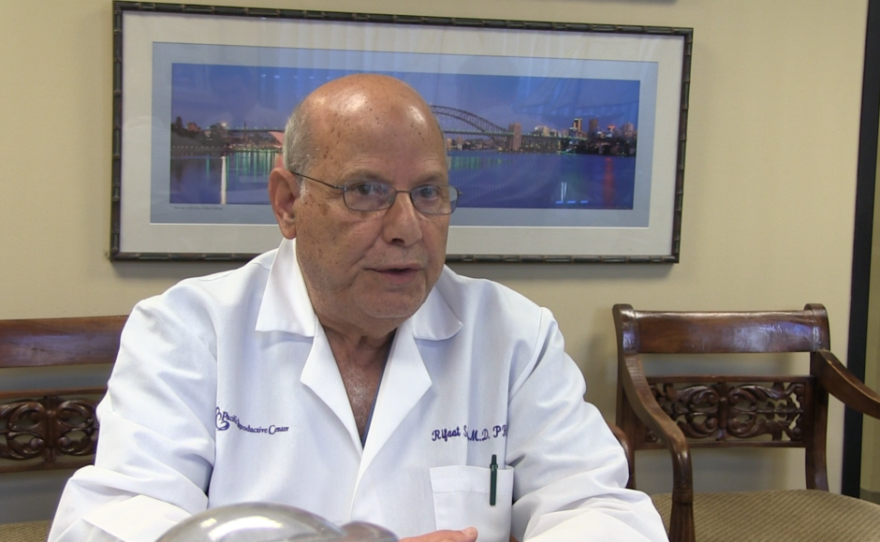
Deposition video courtesy of Malissa Pineda
An intense man at present in his 70s, Salem was a pioneer of fertility medicine when he began his medical career in the 1980s, not long afterward the first "test tube infant" was born.
When IVF first hit the market, the engineering science was met with voracious demand. That demand has only grown as more than Americans filibuster having families until later in life and struggle with infertility.
In IVF, one of the virtually expensive fertility treatments available, a adult female's eggs are combined with sperm in a lab to create embryos. Information technology is now a $3 billion manufacture in the U.South., responsible for more than 1 meg babies.
Salem started at one of the first individual IVF clinics in the country, the Northern Nevada Family Fertility Clinic. He co-wrote i of the start studies on ways to reduce a potentially life-threatening complication from fertility medications and in the years since has pulled off success for people who had little hope of condign a parent.
He is particularly proud of his work with a woman who, after having been shot at age 3, had seven surgeries on her belly. Thanks to IVF handling with Salem, she has two healthy children.
Salem carries himself with the confidence of someone with the ability to create human life. Today, he oversees a multimillion-dollar fertility clinic empire in Southern California, 1 that's rewarded him well.
In 2011, court records estimated his annual income at $3 million. His multimillion-dollar habitation in Palos Verdes Estates has a stunning view of the Pacific Ocean.

Stuart Palley / Reveal
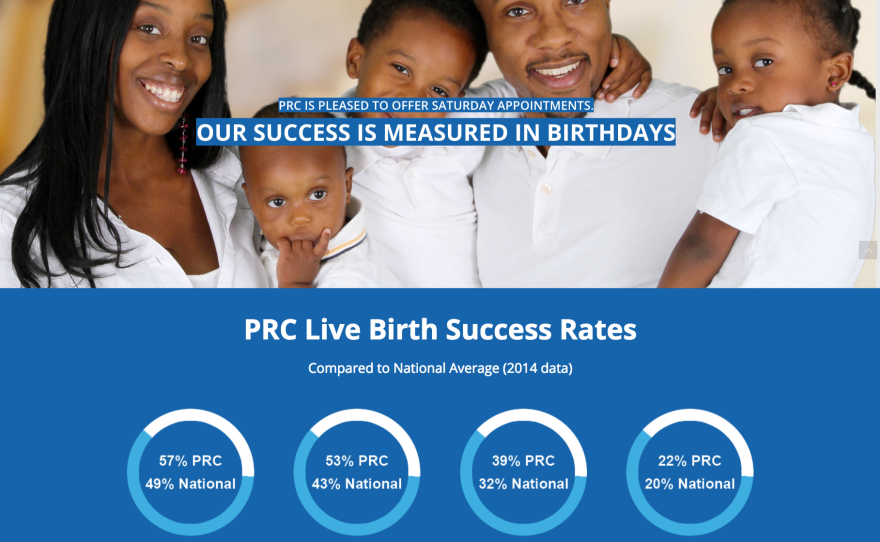
One of the major selling points of Salem's Pacific Reproductive Center is its success rate. In a promotional video, the doctor tells prospective patients that "if you await at our statistics compared to the residuum of the clinics, I think our statistics stand tall."
There'due south truth to his advertising. According to regime data, he has ane of the highest success rates in the state. Women under 35 who went to Salem's four U.Southward. clinics had a 66 percent gamble of having a baby each time they tried in 2015. The dispensary's motto: "Our success is measured in birthdays."
Simply those rates obscure show of a troubled exercise.
Over the course of his career, Salem has been sued x times for medical malpractice in Southern California. He is among the 1 percent of doctors in the United States who accept made 4 payouts for malpractice claims since 1990. Nonetheless he continues to be in proficient standing with the Medical Board of California.
Andrew Vorzimer, an attorney who represents fertility clinics and patients, said the volume of lawsuits Salem has faced is an "extraordinary number of cases" for one doctor.
"We're either dealing with someone with a tremendous amount of airs that can't admit a fault, or in that location's a serious problem going on in that IVF facility," Vorzimer said. "It doesn't bode well for that doctor."
In one example filed in 2007, a jury found that Salem gave patients false promise that they'd be successful with IVF when information technology would take been almost medically incommunicable.
In a case that settled in 2006, a woman declared that Salem had botched a fertility treatment, which required follow-up surgery. The most recent lawsuit, which is ongoing, claims that he pressured a couple to do IVF even though they weren't good candidates, double-billed their insurance and pushed them to fiscal ruin.
Salem says all the lawsuits were filed past "aroused patients." "Patients who come so emotionally here and they exercise non become pregnant, they point the finger to anybody," he said.
In addition, court records show that Salem'south Pacific Reproductive Heart has had a mold problem in its lab in Irvine where embryos are created and stored. And inspection reports of the on-site surgical centers prove that the clinics have been cited for non properly preparation staff and storing drugs. Ane patient has sued Salem'southward surgical center, claiming she almost bled to death during a basic operation considering it failed to stock a critical blood coagulant.
Then at that place'south what happened to the Pinedas in February 2014.
Now in her early 40s, Malissa Pineda is organized, upbeat and warm. A longshoreman at the Port of Long Beach, she's also no-nonsense. She'southward the chief breadwinner, and David's a stay-calm dad. The couple met as teenagers, only they'd reunited only recently on the docks and gotten married in their mid-30s. They are a composite family with iv kids, three of whom live with them in their 1-story ranch firm in a pleasant Inland Empire subdivision.
They relish their domestic life and wanted to continue expanding their family. But Malissa Pineda's latest encounter with Salem had traumatized her. She started having fits of rage and anger. She was crying all the fourth dimension. She couldn't sleep. She did her all-time to push those feelings out of her listen because she believed staying positive would help her become pregnant more easily.
"I was so overwhelmed," she said. "Merely mind you, I had to be focused. I had to have my babies."
Pacific Reproductive Center website
The Pinedas say the only thing they clearly understood later their meeting with Salem was that there had been a mistake and that all of their embryos had been preserved. He promised to requite Malissa a baby – and embrace the costs.
Simply deep downwards, she says she knew that Salem had done something to stop her from getting significant. Information technology turns out that the painful scraping she'd experienced at the clinic had been office of a dilation and curettage, a procedure that can be used for first-trimester abortions. Information technology wasn't until she filed a lawsuit against the physician and the clinic a few months later on that she fully understood the reason why.
When asked to spell out things during litigation, Salem said he had accidentally put someone else's embryos inside her. In that rushed procedure in the exam room, he had removed them.
During his deposition, Salem blamed the botch on the embryologist, Sandra Arias.
Instead of handing him a catheter with iii of Pineda'southward embryos, he said Arias had loaded someone else's genetically aberrant embryos, which were waiting to be discarded. Distracted past the death of her brother-in-law, Arias told him she had forgotten to cheque the proper name on the petri dish.
A second nurse was supposed to verify Pineda'south embryos were beingness used. But that nurse hadn't shown up that morning.
The dr. and the Pinedas disagree on i crucial betoken: The couple say they didn't give Salem permission to terminate an impending pregnancy.
"Nosotros had no clue what was almost to take place, because if he had said all the things that took place, I would accept looked at him and said, 'You're crazy. We're going abode,' " David Pineda said.
Salem claims that when he met with the Pinedas in the clinic conference room, he clearly explained the problem before giving them ii options: Remove the embryos that day or remove them the following day, when more staff were available.
"And they both responded, 'I call back we desire to accept them out today,' " Salem said during his deposition.
Immediately later on the procedure, Salem prescribed a shot to induce a chemic abortion to eliminate any remaining chance that Malissa Pineda would get significant. She says she was led to believe it would terminate the bleeding, but Salem says he had explained what he was doing.
Just there's nil in the courtroom records to prove the doctor'due south claims. Even his own expert witnesses say he didn't follow basic standards of care: He didn't document the medical advice he was offering the couple. He didn't become Pineda's written consent earlier he started the process. And he should have given her more time to think about what she wanted to do, including offering her the option of doing zero.
Psychologist Karen Hall, one of Salem's skillful witnesses, said the doctor should have given Pineda up to 48 hours to think well-nigh whether she wanted the procedure.
"In my opinion, that should have been one of the options for her," Hall said in her deposition. "And I don't – information technology doesn't seem to me that that was given to her."
On the mean solar day that the Pinedas' instance was set to go to trial in September, Salem settled the lawsuit by offering the couple $250,000. Pineda says the thought of sitting in the court was giving her panic attacks.
Past settling, Salem didn't have to acknowledge wrongdoing. He also escaped the scrutiny of the Medical Board of California, which gives the public only limited information on malpractice suits.
Many legal settlements likewise shield cases from public view. The Pinedas are able to discuss their example because they did non sign a confidentiality agreement.
In other fields of medicine, an error is more obvious – the incorrect arm gets amputated or a patient dies afterwards being given the wrong medication. When something goes amiss in IVF, mistakes might be remedied quietly.
"If a doctor screws up in the lab, they can do another IVF cycle," said Andrew Vorzimer, the chaser who specializes in fertility medicine. "If the physician makes a mistake and transfers the incorrect embryo, they can terminate the pregnancy and rectify the situation. So more often than not, these cases tend to go nether the radar."
Salem's troubled history might non be easy to find, but the doctor's success stories are on total display. Every year, Salem hosts a babe reunion where hundreds of his ex-patients and their children turn upward for nutrient and entertainment. For the dispensary, it's the perfect photo op.
He as well has helped people get significant in the near difficult of circumstances.
Concluding year, Lenee Kehnt got a text message from her husband, Jeremi, a Marine and motorbike enthusiast. After 2 previous accidents, he told her that if anything should happen to him, she should observe a way to have their child.
Two months after, he was killed in a motorbike blow. Kehnt fulfilled his wish: A doc rushed to the coroner's office to extract sperm from her hubby'south body. She sent the sperm to Salem, who used it to assistance her excogitate through IVF.
The infant arrived early. On April 21, a month earlier the anniversary of her husband'due south death and weeks before her 35th birthday, Kehnt gave nativity to a girl, Remi, who weighed 5 pounds, 13 ounces.
She remains grateful to Salem. "It gave me a reason to live," she said. "I tin't thank him enough for helping me realize this dream."
In doing so, however, Salem pushed the boundaries of best practices endorsed past industry groups and the authorities. Information technology had nothing to practise with extracting sperm from a corpse.
And information technology acquired Kehnt more than despair.
Scott Anger / Reveal
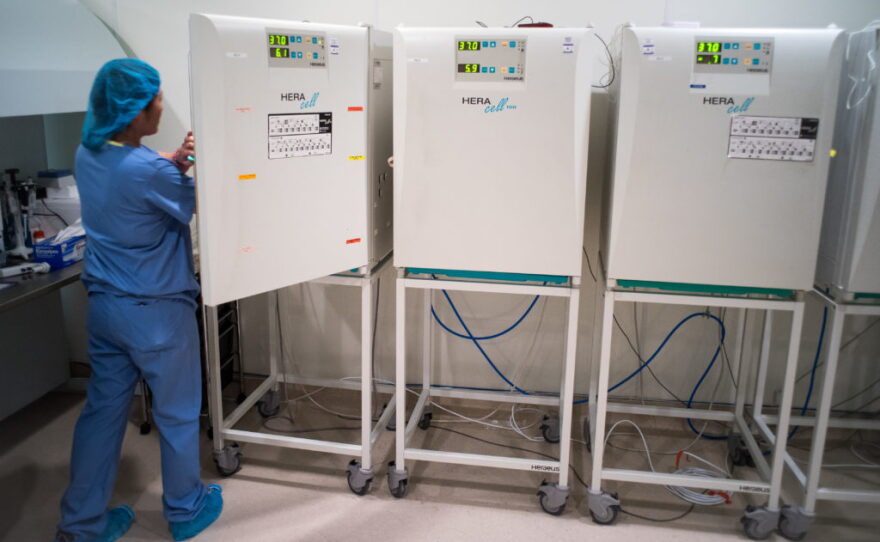
Still reeling from the grief of losing her married man, Kehnt had a decision to make before finishing her IVF cycle. Dr. Rifaat Salem had created two healthy embryos. He wanted to put both in her at one time, she said.
"It was my intention to only do 1," Kehnt said. "Only when information technology was time to exercise the transfer, Dr. Salem said, 'I recommend putting in two.' "
She said she followed the doc'southward communication, only Salem says Kehnt must take asked for two embryos. Regardless, Kehnt was delighted when she heard the pitter-patter of double heartbeats from the 2 embryos in her womb. She immediately bought two cribs and matching sets of apparel.
"I was ready to get a twin mom," she said.
7 weeks into the pregnancy – less than five months after her hubby's decease – Kehnt miscarried one of the embryos. "My heart was broken again," she said.
Kehnt was a strong candidate for using i embryo at a time. It would take offered the best chance of having a babe without increasing the chance of having twins and a miscarriage.
She was under 35, she didn't accept a history of infertility, she had never tried IVF before, and genetic testing had shown that the two embryos slated for transfer were probable to take. Manufacture and government guidelines currently recommend one embryo at a time in cases like hers.
By gambling with Kehnt'southward health and that of her embryos, Salem gave himself the chance to score another point in the game of success rates.
Salem could have transferred i embryo at a time and waited to meet whether each one held. Nevertheless, the Centers for Disease Control and Prevention would accept counted but the get-go transfer – giving him one opportunity to tally a success.
The clinic increased its chances of boosting its rates. Kehnt didn't significantly increase her chances of having a child over the long run.
By transferring more than one embryo at a time, Salem is like many of his colleagues in the industry.
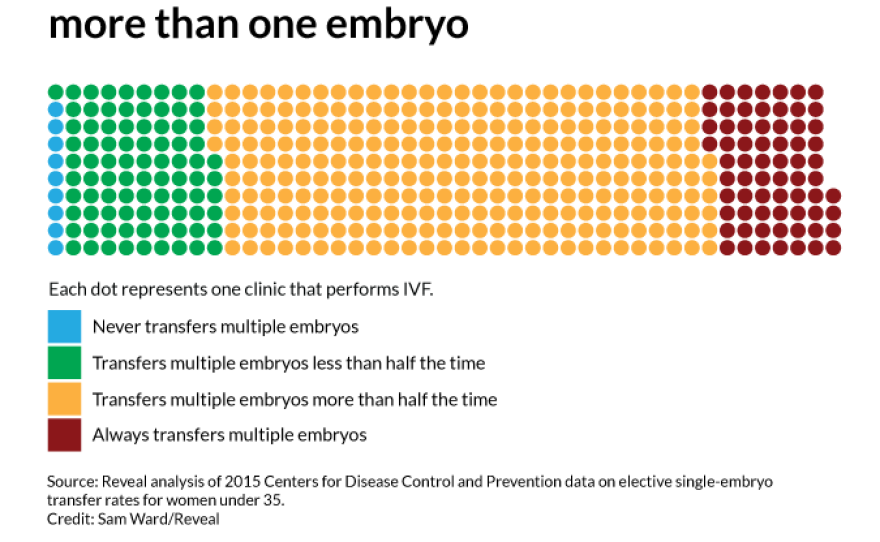
According to a Reveal analysis of 2022 CDC data, nearly 80 pct of in vitro fertilization clinics in the land routinely transfer more than 1 embryo at a time into the youngest patients. These are typically the women who are the to the lowest degree likely to need an extra boost from the transfer of multiple embryos.
About 1 in 7 IVF clinics performed no single-embryo transfers when there was more than i available in women under 35 in 2015.
Sam Ward / Reveal
Fertility doctors say there are times when it may be appropriate to use more than than ane embryo, especially if a patient has failed several rounds of IVF or is having difficulty producing quality embryos.
The CDC keeps more than detailed data that would brand it easier to distinguish betwixt clinics that are ignoring best practices and ones that take on patients with the hardest diagnoses. Just it keeps that data underground.
The agency says information technology withholds information that might cause damage to dispensary personnel and to forestall "embarrassment, persecution and potentially legal and physical harm" to clinics and patients.
Clinics also must work with patients who want twins. And some IVF consumers struggling to pay for treatments out of pocket welcome multiple-embryo transfers because they believe it will meliorate their odds of immediate success.
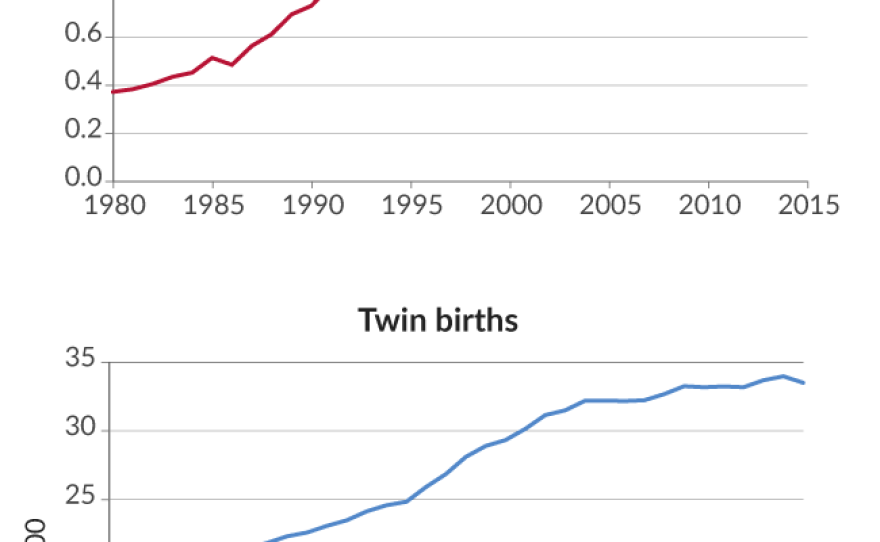
The tendency has helped drive up the twin nascency rate in America, which has increased by more 75 percent since 1980. Today, well-nigh 4 in 10 children conceived through IVF are twins.
Scott Pham / Reveal
Women carrying twins are more likely to give birth to premature babies who require expensive infirmary intendance. Those babies are more likely to experience complications, too, including physical or developmental disabilities.
Mothers carrying twins are more probable to experience complications such as loftier blood pressure level, claret clots and gestational diabetes.
In the example of IVF, these increased risks are largely preventable.
Dr. Fifty. Michael Kettel, head of the San Diego Fertility Middle, says fertility doctors aren't to blame for the loftier number of multiple-embryo transfers.
"It'southward what couples desire," said Kettel, whose clinic produced one of the highest number of twins in California in 2014.
Kettel agrees that the industry is transferring too many embryos, but he thinks things are getting better. He says he won't depict a clear line at one embryo as some clinics exercise.
"It'south something that we feel like we want to give the patient a major role in that controlling process," Kettel said. "Do those patients know they're at adventure of having twins? Yes. Do many of them desire twins despite that risk? Yes."
George Annas, a bioethicist at Boston University's School of Public Health, says that for as well long, clinics have used patient need to justify using multiple embryos at in one case.
"They'll all tell you that the patients demand information technology," he said. "(In) no other field of medicine would the excuse for not doing expert medicine be 'the patients demand information technology.' That's ridiculous."
He believes clinics accept connected to transfer multiple embryos for a unproblematic reason: to heave their success rates. "They just try to keep their numbers up," he said.
Change has been slow in coming. Recently, the leading industry groups, the American Society for Reproductive Medicine and the Society for Assisted Reproductive Applied science, have tweaked their guidelines and the manner they analyze and publish data to encourage more single-embryo transfers and remove incentives to pump upward success rates.
Many northern European countries and Australia accept instituted policies promoting single-embryo transfers to reduce multiple pregnancies. They've seen their twin rates plummet.
Although the U.S. arrangement has been criticized for incentivizing bad practices since the 1990s, the CDC won't begin publishing improved data that addresses the problem until 2019.
Success rates are easy to misunderstand and easy to manipulate. In addition to transferring too many embryos at in one case, clinics might take on just the easiest cases. They can push patients with low chances for success into other treatments not tracked by the CDC. Some clinics choose to advertise pregnancy rates instead of alive-birth rates, knowing that miscarriages will inevitably happen.
Fifty-fifty when success is measured past live births, the numbers can exist deceiving. For the purpose of statistics, information technology doesn't matter whether babies or mothers suffer health complications before, during or shortly later on birth. In Salem's case, Kehnt's newborn – even following the miscarriage of her twin – volition count equally a success.
The health risks related to twins might seem to exist in the domain of statistics and theoretical risk. But for Janet Farrell Leontiou, the effects are real.
First in her tardily 30s, she tried IVF several times, each time agreeing to have multiple embryos implanted on the advice of her doctor, who was non Salem. When 2 out of 3 embryos implanted, she was ecstatic. At 45 years onetime, she was going to exist the mother of twins.
Two days after the twins' birth in 2002, her son Andreas started to have seizures. He was transferred to the neonatal intensive care unit for the side by side five weeks and a yr later was diagnosed with cerebral palsy, a neurological disorder that impairs musculus coordination. Twins are more than four times every bit likely to take information technology as single children.
Her other son, Zachary, is healthy. While information technology's impossible to know what acquired Andreas' disability, what bothers Leontiou is that no i raised the business organization about the increased gamble of complications from multiples. Had she been informed of the risks, she insists she would take taken her chances with a single-embryo transfer.
"Information technology's hard to wrap your head around why fertility doctors are doing it this way," said Leontiou, a professor of communication and author of the book, "What Do the Doctors Say?" "They're supposed to exercise no damage. Yet they are adding tremendously to the number of disabled people in this country who will demand intendance for years and years and years. I know because I'm affected."
When things become wrong, the costs add up. On crowdfunding sites, dozens of IVF patients seek assist with their medical bills. Some of these costs are picked upward by insurance companies.
More widely adopting single-embryo transfers in the U.S. could save most $1 billion a year in wellness care costs, according to a 2011 analysis by leading researchers.
Dr. Rifaat Salem rarely transfers one embryo at a time. In women under 35, he performed a single-embryo transfer 5.7 percent of the time. In 2014, 4 of every x babies born from Salem's clinics were twins, triplets or more.
In Malissa Pineda's case, Salem inserted three embryos. He says it's what the couple wanted. The Pinedas say Salem never gave them any other option.
The Pinedas will never know what might have happened with those iii mistakenly transferred embryos if Salem had not removed them. The couple's spiritual behavior never would have led them to finish a pregnancy, Malissa said. The thought of what could have been still drives Malissa to tears and leaves David seething.
"We would have kept them, all of them," Malissa said.
Later leaving the Pacific Reproductive Center, they took their business elsewhere. Malissa Pineda got pregnant twice more through IVF, just both ended in miscarriage.
For her, the stress of what happened took a toll. She experienced silly spells and nausea. She would lose her remainder and fall. At work, she was taken off rigorous assignments.
And so came severe anxiety and retentivity lapses. One day while Pineda was shopping at Costco, she had a panic assault in the shop. Piper Joy, who was 6 at the fourth dimension, had to find her mother'south telephone to call her dad then he could pick them upwards.
Pineda was diagnosed with depression and anxiety, which her therapist believes was related to her experience at the Pacific Reproductive Center. She took antidepressants for awhile, but she didn't like the way they made her feel. She has establish some respite in meditation.
The couple still call back nigh their experience with Salem almost every solar day. And they all the same oasis't found an reply to the riddle of infertility, which leaves them swinging between finding acceptance and a persistent hope that they'll still be able to have a baby i day.
"I even so have then much more love in my heart," Malissa said.
Only the Pinedas have given up on the fertility manufacture. They've become cynical almost the doctors who, to them, seemed more interested in making money than helping patients.
"Nobody cared," David said. "They wanted to showtime some other cycle considering they knew they were getting paid again."
Solutions: Read ideas on how to gear up the issues we institute.
Source: https://www.kpbs.org/news/midday-edition/2017/06/05/when-pregnancy-dreams-become-ivf-nightmares

Enregistrer un commentaire for "Dreamt About My Husband and I Having a Baby Using Ivf"