Which Two Criteria Must Be Met Before Scientists Can Use Radiocarbon Dating
17.6: Radiocarbon Dating: Using Radioactivity to Measure the Age of Fossils and Other Artifacts
- Folio ID
- 161977
Learning Objectives
- Identify the historic period of materials that can be approximately determined using Radiocarbon dating.
When we speak of the element Carbon, we most often refer to the about naturally abundant stable isotope 12C. Although 12C is definitely essential to life, its unstable sis isotope xivC has become of extreme importance to the scientific discipline world. Radiocarbon dating is the process of determining the age of a sample by examining the amount of 14C remaining against its known one-half-life, 5,730 years. The reason this process works is because when organisms are live, they are constantly replenishing their 14C supply through respiration, providing them with a abiding amount of the isotope. Nonetheless, when an organism ceases to exist, information technology no longer takes in carbon from its surround and the unstable 14C isotope begins to decay. From this science, we are able to gauge the date at which the organism lived on Earth. Radiocarbon dating is used in many fields to learn information about the past conditions of organisms and the environments present on Earth.
The Carbon-fourteen Cycle
Radiocarbon dating (ordinarily referred to merely as carbon-14 dating) is a radiometric dating method. It uses the naturally occurring radioisotope carbon-14 ( 14C) to gauge the age of carbon-bearing materials up to about 58,000 to 62,000 years old. Carbon has two stable, nonradioactive isotopes: carbon-12 (12C) and carbon-13 (13C). There are also trace amounts of the unstable radioisotope carbon-14 (14C) on Earth. Carbon-fourteen has a relatively brusk half-life of 5,730 years, meaning that the fraction of carbon-14 in a sample is halved over the course of 5,730 years due to radioactive decay to nitrogen-14. The carbon-14 isotope would vanish from Globe'due south atmosphere in less than a million years were it non for the constant influx of cosmic rays interacting with molecules of nitrogen (Due north 2 ) and single nitrogen atoms (North) in the stratosphere. Both processes of germination and decay of carbon-xiv are shown in Figure 1.
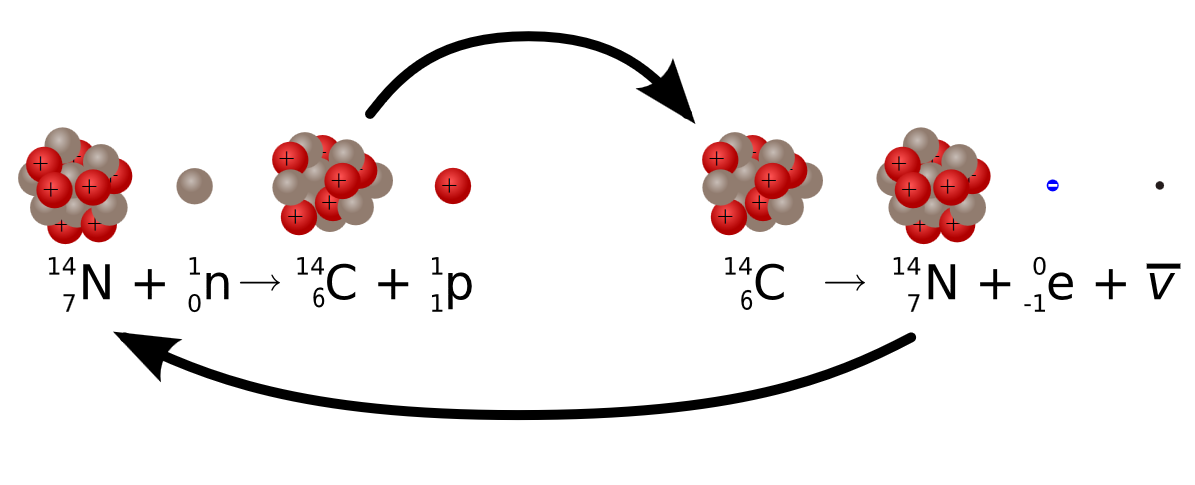
When plants fix atmospheric carbon dioxide (CO 2 ) into organic compounds during photosynthesis, the resulting fraction of the isotope 14C in the found tissue will match the fraction of the isotope in the atmosphere (and biosphere since they are coupled). Subsequently a plant dies, the incorporation of all carbon isotopes, including 14 C, stops and the concentration of 14C declines due to the radioactive decay of 14 C post-obit.
\[ \ce{ ^{xiv}C -> ^{14}N + e^-} + \mu_e \label{E2}\]
This follows start-order kinetics:
\[N_t= N_o due east^{-kt} \label{E3}\]
where
- \(N_0\) is the number of atoms of the isotope in the original sample (at time t = 0, when the organism from which the sample is derived was de-coupled from the biosphere).
- \(N_t\) is the number of atoms left after time \(t\).
- \(k\) is the charge per unit abiding for the radioactivity.
The one-half-life of a radioactive isotope (normally denoted by \(t_{1/2}\)) is a more than familiar concept than \(k\) for radioactivity, then although Equation \(\ref{E3}\) is expressed in terms of \(one thousand\), information technology is more than usual to quote the value of \(t_{1/ii}\). The currently accepted value for the half-life of 14C is five,730 years. This means that after v,730 years, but half of the initial fourteenC will remain; a quarter will remain later on 11,460 years; an eighth later on 17,190 years; and and so on.
The equation relating rate abiding to half-life for commencement order kinetics is
\[ yard = \dfrac{\ln 2}{ t_{1/2} } \label{E4}\]
so the rate abiding is and then
\[ k = \dfrac{\ln 2}{5.73 \times x^3} = one.21 \times 10^{-four} \text{year}^{-1} \label{E5}\]
and Equation \(\ref{E2}\) can be rewritten every bit
\[N_t= N_o east^{-\ln ii \;t/t_{one/two}} \characterization{E6}\]
or
\[t = \left(\dfrac{\ln \dfrac{N_o}{N_t}}{\ln ii} \correct) t_{1/2} = 8267 \ln \dfrac{N_o}{N_t} = 19035 \log_{10} \dfrac{N_o}{N_t} \;\;\; (\text{in years}) \label{E7}\]
The sample is causeless to accept originally had the aforementioned 14C/12C ratio as the ratio in the temper, and since the size of the sample is known, the full number of atoms in the sample tin be calculated, yielding \(N_0\), the number of fourteenC atoms in the original sample. Measurement of N, the number of 14C atoms currently in the sample, allows the calculation of \(t\), the age of the sample, using the Equation \(\ref{E7}\).
Note
Deriving Equation \(\ref{E7}\) assumes that the level of fourteenC in the temper has remained constant over fourth dimension. However, the level of xivC in the atmosphere has varied significantly, so time estimated by Equation \(\ref{E7}\) must exist corrected by using data from other sources.
Example 1: Dead Ocean Scrolls
In 1947, samples of the Dead Sea Scrolls were analyzed by carbon dating. Information technology was found that the carbon-fourteen present had an action (rate of decay) of d/min.g (where d = disintegration). In dissimilarity, living material exhibit an activeness of 14 d/min.g. Thus, using Equation \(\ref{E3}\),
\[\ln \dfrac{14}{11} = (i.21 \times 10^{-4}) t \nonumber\]
Thus,
\[t= \dfrac{\ln 1.272}{1.21 \times 10^{-4}} = 2 \times x^3 \text{years} \nonumber\]
From the measurement performed in 1947, the Dead Sea Scrolls were determined to be 2000 years old, giving them a date of 53 BC, and confirming their authenticity. This discovery is in contrast to the carbon dating results for the Turin Shroud that was supposed to take wrapped Jesus' body. Carbon dating has shown that the cloth was made between 1260 and 1390 Advertizing. Thus, the Turin Shroud was made over a thousand years after the expiry of Jesus.
Describes radioactive half-life and how to do some uncomplicated calculations using half-life.
History
The technique of radiocarbon dating was developed by Willard Libby and his colleagues at the University of Chicago in 1949. Emilio Segrè asserted in his autobiography that Enrico Fermi suggested the concept to Libby at a seminar in Chicago that twelvemonth. Libby estimated that the steady-state radioactivity concentration of exchangeable carbon-14 would be about xiv disintegrations per minute (dpm) per gram. In 1960, Libby was awarded the Nobel Prize in chemistry for this piece of work. He demonstrated the accuracy of radiocarbon dating past accurately estimating the age of woods from a series of samples for which the historic period was known, including an ancient Egyptian imperial barge dating from 1850 BCE. Before Radiocarbon dating was discovered, someone had to find the beingness of the 14C isotope. In 1940, Martin Kamen and Sam Ruben at the Academy of California, Berkeley Radiations Laboratory did just that. They found a form, an isotope, of Carbon that contained 8 neutrons and 6 protons. Using this finding, Willard Libby and his team at the Academy of Chicago proposed that Carbon-fourteen was unstable and underwent a total of xiv disintegrations per minute per gram. Using this hypothesis, the initial one-half-life he determined was 5568, give or take thirty years. The accurateness of this proposal was proven by dating a piece of wood from an Ancient Egyptian barge, the historic period of which was already known. From that point on, scientists take used these techniques to examine fossils, rocks, and ocean currents; as well every bit to determine age and result timing. Throughout the years, measurement tools have go more technologically avant-garde, allowing researchers to be more precise. We at present apply what is known as the Cambridge half-life of 5730+/- 40 years for Carbon-14. Although information technology may be seen every bit outdated, many labs withal use Libby's half-life in order to stay consistent in publications and calculations inside the laboratory. From the discovery of Carbon-fourteen to radiocarbon dating of fossils, we can see what an essential office Carbon has played and continues to play in our lives today.
Summary
The unabridged process of Radiocarbon dating depends on the decay of carbon-14. This procedure begins when an organism is no longer able to exchange Carbon with its environment. Carbon-14 is first formed when cosmic rays in the atmosphere allow for excess neutrons to exist produced, which and so react with Nitrogen to produce a constantly replenishing supply of carbon-14 to exchange with organisms.
- Carbon-14 dating can be used to estimate the age of carbon-bearing materials up to about 58,000 to 62,000 years old.
- The carbon-14 isotope would vanish from Earth's temper in less than a million years were information technology not for the constant influx of cosmic rays interacting with atmospheric nitrogen.
- One of the nearly frequent uses of radiocarbon dating is to approximate the age of organic remains from archeological sites.
References
- Hua, Quan. "Radiocarbon: A Chronological Tool for the Recent By." Quaternary Geochronology4.five(2009):378-390. Science Direct. Web. 22 Nov. 2009.
- Petrucci, Ralph H.General Chemistry: Principles and Modern Applications 9th Ed. New Bailiwick of jersey: Pearson Education Inc. 2007.
- "Radio Carbon Dating." BBC- Homepage. 25 Oct. 2001. Web. 22 Nov. 2009. http://www.bbc.co.uk.
- Willis, E.H., H. Tauber, and Grand. O. Munnich. "Variations in the Atmospheric Radiocarbon Concentration Over the By 1300 Years." American Journal of Scientific discipline Radiocarbon Supplement 2(1960) ane-4. Print.
Problems
- If, when a hippopotamus lived, there was a total of 25 grams of Carbon-xiv, how many grams will remain 5730 years after he is laid to balance? 12.5 grams, because one half-life has occurred.
- How many grams of Carbon-14 volition be present in the hippopotamus' remains after three half-lives have passed? 3.125 grams of Carbon-14 will remain after three one-half-lives.
Source: https://chem.libretexts.org/Courses/can/intro/17:_Radioactivity_and_Nuclear_Chemistry/17.06:_Radiocarbon_Dating:_Using_Radioactivity_to_Measure_the_Age_of_Fossils_and_Other_Artifacts

Enregistrer un commentaire for "Which Two Criteria Must Be Met Before Scientists Can Use Radiocarbon Dating"