How to simply grow the church

Yesterday I had a delightful, brief conversation with a friend about what is happening in different dioceses.
Friend: Our bishop has turned our diocese around.
Me: How has he done that?
Friend: By non cut clergy posts, and not appointing an archdeacon. Instead we have focussed on the question of stewardship.
Me: Surely it isn't equally uncomplicated as that?
Friend: No, not entirely, but other dioceses are doing the same. The problem is that likewise many have developed a groupthink from twenty years ago, that when you are struggling financially the reply is to cut clergy posts.
I was struck by this, considering another friend had shared a mail I wrote seven years ago on church growth, and then I am sharing information technology again here. Information technology offers a vital groundwork to the recent spats about church planting, the function of clergy, 'limiting factors', and whether or non the decline in attendance for the Church of England volition ever turn around.
 A number of years ago, a friend of mine was leaving theological education to go dorsum into parish ministry. 'I'll simply become and grow the church for a few years', he said blithely. I thought he was a fool to be then presumptuous. Yes, growing a church is like shooting fish in a barrel: all you need to exercise is exit any security of domicile or livelihood, choose someone who will beguile you lot, perform miracles, including raising the expressionless, upset the authorities, get crucified, and rise again. Easy!
The Church Growth Research Centre, set up and funded past the various institutions of the Church building of England, has simply reported ('From chestnut to evidence') on factors in church growth. Of course, this is not the beginning time that people have been thinking about the human factors in church growth. The Revivalism in 19th-century America, led past Charles Finney and others, was driven to a large extent by a belief in creating the right conditions past which people would come to organized religion. And more recently the Church Growth Movement of the 1970s, led by Donald McGavran and C Peter Wagner at Fuller Seminary in California, advocated the Homogenous Unit Principle as vital for growing churches. (There is a good evaluation of this in a Lausanne Occasional Paper.) At every indicate, the idea that at that place are specific 'conditions for growth' is hotly contested. Later all, Paul talks about his work and the work of other leaders as of import, only simply in the context where 'God gives the growth' (one Cor 3.6). And Jesus appears in the gospels to aspect the growth of the kingdom to often mysterious, divine, forces. I accept long pondered the phrase in Marker four.28: the soil produces the grain 'all by itself', in Greekautomate. (The give-and-take merely occurs hither and in Acts 12.10).
And so it was no surprise to run across Justin Welby hedging his bets—or perhaps taking a 'both/and' approach—in the press release for the Church Growth report.
The turnaround of the church is fundamentally in the hands of God. God is faithful. He has shown that in Jesus Christ, and He shows that to united states of america every day in our lives—and in the lives of our churches together. But He calls on us to be his feet, his hands, his mouth, his eyes, his ears, who mind to and serve and dearest the people around us, who above all witness to the reality of the dearest of Jesus Christ.
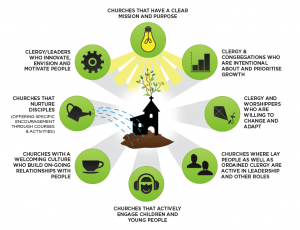
A good executive summary of the findings tin be found here. It makes interesting reading, and deserves to exist taken notice of at every level. There were a number of things that stood out for me, and some implications which I think need teasing out more than fully.
I interesting observation is that growth does not correlate with theological tradition—no 1 tradition inside the Church has a monopoly on growth. This is worth reading with a footling 'hermeneutic of suspicion', since information technology would be difficult if not impossible for a Church building-funded group to say otherwise. And it would suggest that the mix of traditions in the C of East stays constant, when we know this is not the case. But the study besides makes 2 other observations the undermine this. The first is that churches grow (amongst other reasons) if the leadership are intentionally focussed on growth. This tin happen anywhere, merely some theological and church building traditions are more acquiescent to this than others. The second is that cathedral attendance has grown significantly, and it would exist difficult to suggest that cathedrals accept no ecclesial tradition!
 This concluding fact (which has been noted before) offers two key challenges to the local church building. The starting time is to recognise that dissimilar styles of worship appeal to different people, often at dissimilar times of one'southward life. A key recipe for growth, and then, would exist to retain diversity of worship styles across different congregations coming together in the same building. This is reinforced by the fact of growth in 'fresh expressions' of church, particularly 'cafe-fashion' services. (You lot need to be careful with this term; I take been to supposed buffet-mode services which were just traditional, but seated around tables.) This is surely a really practiced statement for planting congregations of different styles at different times of day within the aforementioned 'church.' Don't think that just starting up a worship band will solve all your growth bug. People desire depth as well as cultural resonance—and U.k. culture is pretty diverse these days.
Just the second fundamental challenge posed by the growth in cathedral worship is this: what kind of growth are nosotros looking at? Counting 'bums on seats' is one thing, and not unimportant. Merely this growth has particularly been in cathedral mid-week services, and has been described as 'believing without belonging.' Is information technology even this? Attending a formal service with choral music without any sense of communal relationship could be nostalgia or (the sceptical might say) hedging one's bets as the grave looms nearer! If 'church growth' is anything, it must include growth in discipleship and understanding, non just numbers. Still, discipleship cannot happenwithout omnipresence, so this must be a practiced showtime.
The report goes on to explore question of leadership, and notes:
The leadership qualities which stood out in the survey as existence meaning in relation to growth included:
- Motivating
- Envisioning
- Innovating
Other important elements of leadership behaviour which are likely to be associated with growth include:
- Having the power to appoint with outsiders and newcomers
- Being intentional about worship style and tradition
- Having a vision for growth and doing new things to make it happen
- Prioritising growth
- Being skillful at developing a vision and goals
- Abilities in training people for ministry and mission
Although no more is made of this, these observations have significant implications for training of clergy and other leaders. What strikes me well-nigh these qualities is that, although at that place are elements of skill that are present hither, fundamentally these things are near a person's bones orientation in life—they are virtually grapheme. So if nosotros want leaders who are going to grow churches, nosotros need grooming which focuses less on skills and competence, and more on the deep formation of character. Is it possible to do this whilst cramming a total-time theology caste into a part-time programme, with either connected piece of work or ministry involvement alongside? Or do we need to ready aside our time to come leaders for a procedure of formation? This is of class a question about total-time versus office-fourth dimension grooming. I realise that this is not the but question to ask about preparation, but it is an of import one, and I recall it has been sidelined by more than pragmatic considerations progressively since the Hind report more than than ten years ago, which in upshot turned theological education into a market. Nosotros will alive to regret it—bold growth overtakes decline, that is.
A second implication for preparation relates to the second part of ordination preparation, the curacy. Equally John Leach pointed out some years agone in his Grove booklet P 72Visionary Leadership in the Local Church, curates should all be placed in growing churches, to 'breath the air' and form their ain expectations for ministry and leadership.
Finally, this study has a serious challenge to diocesan and national strategy, though information technology is one that is hidden, since it is by fashion of omission. At every betoken there is the implication, never spelled out, that congregations need leadership—trained, theologically competent, just most crucially stipendiary leadership, that is, leaders who are set bated to give time to lead the congregation. I have never heard of any design of church building growth, in any context, at whatever time of history, which did not involve leaders who had been set aside for the task of leadership. (Look at the importance of this to Paul in Acts 18.5.) To imagine that we could lose xl% of stipendiary clergy in the next 10 years through retirement, and non see continued, even dramatic, further decline in omnipresence is to live in a fantasy world. This is not to be clericalist, or deny the importance of lay leadership. In my diocese (Southwell and Nottingham) the concluding bishop Paul Butler committed to replace lost clergy posts with stipendiary lay posts, and in fact i of the examples in the Church Growth written report was one such instance. But nationally to program for a decline in stipendiary leadership is to programme for the church as a whole to decline.
Almighty God,
you lot have entrusted to your Church
a share in the ministry of your Son our great high priest:
inspire by your Holy Spirit the hearts of many
to offer themselves for the ministry of your Church,
that strengthened by his power,
they may work for the increase of your kingdom
and gear up forrad the eternal praise of your name;
through Jesus Christ your Son our Lord.Amen
(Collect for Ember Days)
If you enjoyed this, practise share information technology on social media (Facebook or Twitter) using the buttons on the left. Follow me on Twitter @psephizo. Similar my folio on Facebook.
Much of my work is done on a freelance basis. If you accept valued this post, you can make a single or repeat donation through PayPal:
Comments policy: Good comments that appoint with the content of the postal service, and share in respectful contend, can add real value. Seek start to sympathise, and so to be understood. Brand the nigh charitable construal of the views of others and seek to acquire from their perspectives. Don't view debate every bit a conflict to win; accost the argument rather than tackling the person.
Source: https://www.psephizo.com/life-ministry/how-to-simply-grow-the-church/

Enregistrer un commentaire for "How to simply grow the church"